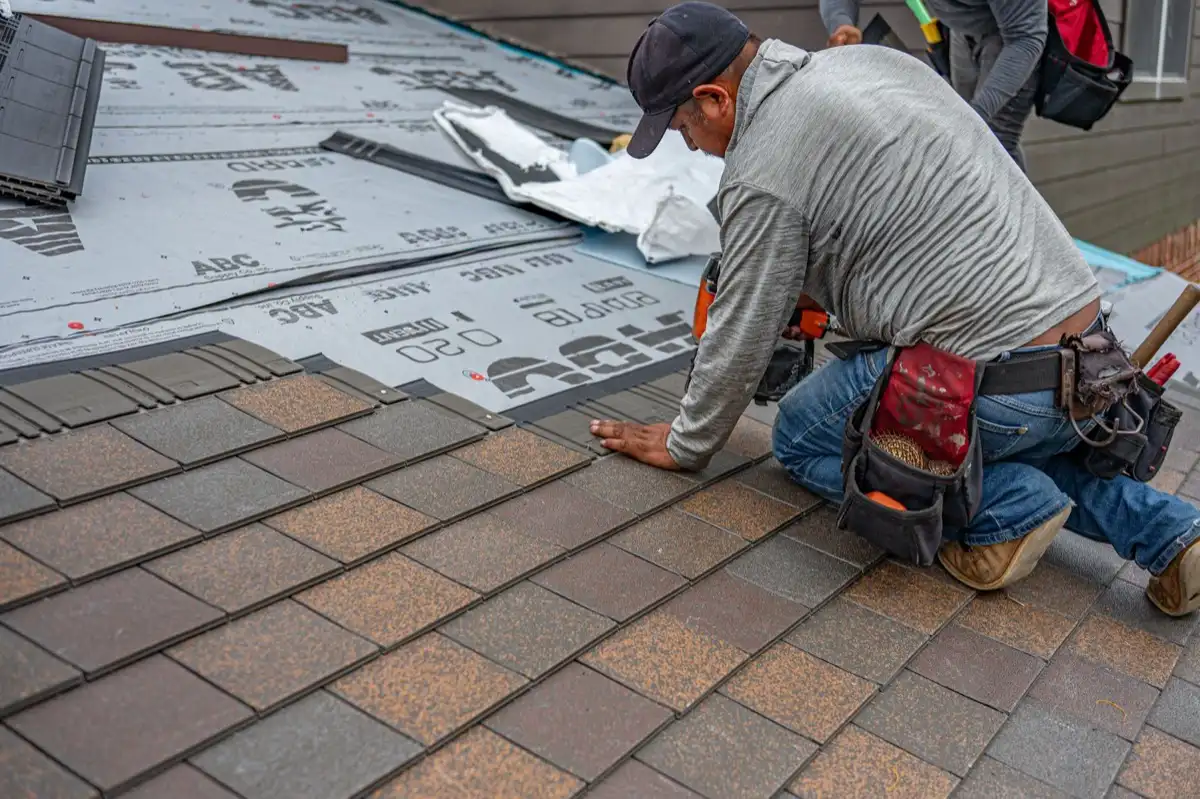
A typical single-family asphalt re-roof is one to three days of on-site work. The calendar between signing the contract and hearing hammers is usually much longer than that, and it is the part nobody sets expectations about.
The work is short, loud, and finished before you have finished being annoyed by it. That is roughly the correct expectation.
The realistic timeline, start to finish
| Stage | Typical duration |
|---|---|
| Inspection and bid | Same visit to a few days |
| Contract, permit, material order | Days to a few weeks |
| Crew scheduling | Days normally, weeks to months after a regional storm |
| Delivery and staging | Day before, or morning of |
| Tear-off | Half a day to a full day per layer |
| Decking repair | Hours, if any |
| Underlayment and dry-in | Same day as tear-off, always |
| Shingles, flashing, ventilation | One to two days |
| Cleanup and magnetic sweep | Final hours |
| Final inspection, if permitted | Days after completion |
The one non-negotiable row is dry-in. Whatever is torn off in a day gets underlayment over it before the crew leaves. Bare decking overnight is not a scheduling choice, it is a risk transferred to you.
What drives it longer
Pitch. Past roughly 7:12 the crew is working in harnesses with roof jacks and staged bundles, and production per hour falls sharply. Steep roofs are not harder to build, they are slower.
Layers. Two layers of tear-off is double the labor, double the disposal weight and often an extra dumpster.
Complexity. Valleys, dormers, saddles, skylights and chimneys are hand-formed flashing work. A cut-up hip roof takes noticeably longer than a plain gable of identical area.
Material. Tile and slate are days, not a day, and they are heavy enough that staging becomes its own task. Standing seam metal is a specialty crew and a longer schedule.
Decking surprises. Rotten sheathing found at tear-off adds hours and a supplement. This is normal, and it is why your contract needs a per-sheet price rather than a hopeful silence.
Weather. Obviously. Also less obviously: a crew that will not open a roof under a marginal forecast is being professional, not slow.
The scheduling part nobody warns you about
Here is the pattern in every storm market. A hail event hits, every local crew is booked eight weeks out, and within seventy-two hours trucks with out-of-state plates are in the neighborhood offering to start tomorrow.
Tomorrow is the sales pitch. It works because the alternative is waiting, and a wait feels like a risk when your ceiling is stained.
A local crew three weeks out is almost always the better purchase than an unknown crew tomorrow, for the plain reason that a workmanship warranty is only worth the continued existence of the company holding it. Use the three weeks to get the roof inspection documented and the scope agreed. Tarping holds a roof for a lot longer than people assume.
How to prepare, in about an hour
Move the cars. Out of the driveway and away from the drip line. Tear-off drops nails and debris and no sweep is perfect on day one.
Cover or clear the attic. Decades of dust comes through the decking gaps when the old roof comes off. Same for garage shelving under an attached roof.
Take things off the walls. Anything hanging on a wall that shares framing with the roof, and anything fragile on a high shelf. Hammering is a vibration, not just a sound.
Move patio furniture, planters and the grill away from the walls beneath the work.
Plan around the noise. If you take calls from home, book the quiet work for those days. If there is an infant or a night-shift sleeper in the house, say so before the crew arrives rather than after.
Put the dog somewhere else. Gates get left open, strangers walk the perimeter all day, and the noise is genuinely distressing to animals.
Day by day, on a normal job
Morning of day one the dumpster and material arrive, tarps go down over landscaping, and tear-off starts on the largest accessible slope.
Through day one old material comes off, decking gets inspected and any bad sheets get replaced, and the exposed area gets underlayment before the crew leaves. Photographs of replaced decking should be taken now, because in twelve hours nobody can see it.
Day two is starter course, shingles up the slopes, new flashing at every penetration and transition, pipe boots, ridge cap and ventilation.
End of the job is a magnetic sweep of yard, driveway and street, debris out, dumpster gone, and a walkthrough where the crew lead shows you the ventilation and the decking photos.
The California paperwork that can move the date
Timelines slip on permits far more often than on weather or materials, and who may pull one is settled at the state line.
C-39 is the CSLB roofing classification, and here is the check most people miss: a C-39 must carry workers compensation whether or not it has employees, so an active roofing license with an exemption on file is a red flag. Your down payment is capped at ten percent or a thousand dollars, whichever is less. If the contractor turns out to have been unlicensed, you can sue to recover everything you paid, however good the work was.
A claim adds a second calendar on top of that one, and the insurer owns it.
California ties every cancellation window to the day you sign, not to what your insurer decides - so a denial three weeks later leaves you with no statutory way out. You get three days normally, five if you are a senior citizen, and seven only where a disaster has actually been declared by the President, the Governor or your local executive officer. The notice must be twelve-point boldface, immediately next to where you sign.
What can honestly wait
Not every roof needs to be done this month, and we say so often. If the roof inspection comes back with four good years and no active leak, waiting until the off-season is a reasonable financial decision, and late autumn or winter scheduling in a mild climate is frequently both faster and cheaper than mid-summer.
The exception is water already in the decking. Once sheathing is wet, waiting is not saving money, it is buying more decking.
Bottom line
Expect one to three days of work and a longer wait to get there, especially after a regional storm. Insist that nothing is left open overnight, get a per-sheet decking price in the contract, get photographs of anything replaced under the shingles, and prepare the attic and the driveway the day before. Then plan to be somewhere else between roughly eight and four.
Costa Mesa Roof Pros schedules roof replacement, asphalt shingle roofs and written roof inspections across Costa Mesa and coastal Orange County, with a real start date rather than an optimistic one. Call (888) 863-4348 and we will tell you what your roof needs and when we can actually be there.
Ready for a free quote in Costa Mesa?
Costa Mesa Roof Pros — free estimate, clear scope, no pressure. Use the form on this page or jump to the homepage quote.
Related services in Costa Mesa
Costa Mesa Roof Pros money pages — go straight to the service you need.
- Roof Replacement →
A replacement here begins with a tape measure on the slope, not a color brochure. Whether a plane sits above or below 2:12 decides which paragraph of the state energy code the plan checker applies to it, and the two paragraphs ask for genuinely different products.
- Roof Inspections →
An inspection here has one job the rest of the county does not think about much: establishing which code paragraph your roof lives under. That is decided by pitch, by assembly weight and by area, and all three are measurements rather than opinions.
- Asphalt Shingle Roofing →
Here is the honest position, and it costs us money to say it. On a steep-slope Costa Mesa house you do not need a cool-rated shingle to satisfy the state energy code, because the prescriptive requirement for single-family steep-slope reroofs applies in Climate Zones 4 and 8 through 15.
- Roof Leak Repair →
The single most useful thing a homeowner here can know is that a repair does not drag the energy code onto the whole roof. The prescriptive requirement attaches above half the roof area or 2,000 square feet, whichever is less, so a targeted repair stays a repair.
- Storm Damage Roof Restoration →
Storm work in coastal Orange County is mostly water, not impact. A long atmospheric river lands rain on shallow planes for two days at a time, and roofs that shed a normal shower fine begin to leak at laps, at reverse slopes and wherever a previous crew relied on sealant.
Frequently asked questions
How long does a roof replacement take?
One to three days of on-site work for a typical single-family asphalt roof. Simple single-story gable roofs are frequently a single long day. Steep, cut-up, multi-layer, tile, or large roofs run three days to a week or more. The work itself is rarely the long part. Permitting, material lead time and crew scheduling usually account for most of the calendar between signing and starting.
Do I need to leave the house during a roof replacement?
No, and most people stay. It is genuinely loud, it vibrates the ceiling, and hammer noise carries through the whole structure, so if you work from home on calls or have a napping infant, plan around it. Park cars away from the house, because tear-off drops debris and nails wherever gravity takes them regardless of how careful the crew is.
What happens if it rains during my roof replacement?
A competent crew tears off only what it can dry in and does not open more roof than the forecast allows. If weather arrives mid-day, the exposed area gets covered with underlayment or tarps before anybody leaves. What you should confirm before starting is that nobody plans to leave bare decking overnight under any circumstances.
Why does the schedule take weeks when the work takes days?
Permits, material ordering and crew availability. In the weeks after a regional hail or wind event every crew in the market is committed, and lead times stretch from days to months. That is also the window when out-of-town storm crews appear offering to start tomorrow, which is precisely the offer worth declining.
Will I need to clear my attic?
It helps considerably. Tear-off shakes loose decades of dust and small debris through gaps in the decking, so anything stored directly under the roof deck should be covered or moved. The same applies to garage shelving under an attached roof, and to anything fragile hanging on walls that share framing with the roof.
What should be finished before the crew leaves?
Full magnetic nail sweep of the yard, driveway and street, debris removed, dumpster gone, new flashing visible at every location, and a walkthrough with you where the crew lead shows you the ventilation and any decking that was replaced. Get the photographs of replaced decking. That is the part you paid for and cannot see anymore.
Local context
How this applies in Costa Mesa, CA
Every article here is written from roofing work done in Costa Mesa and coastal Orange County, so the numbers reflect local labour, permit and material costs rather than a national average. Your own job can land either side of them depending on access, the condition of what is already there, and the materials you pick — aged solar reflectance, thermal emittance, the Solar Reflectance Index.
The way to turn any of this into a real answer is to have someone look at your actual situation. The free estimate is free, itemized and written down, with no deposit and no obligation. Call (888) 863-4348 or start on the Costa Mesa Roof Pros homepage.
Areas Costa Mesa Roof Pros covers
Costa Mesa first, then the surrounding communities of coastal Orange County. Each has its own page with local detail rather than a copy of this one:
- Newport Beach, CA — Orange County, population 85,239
- Huntington Beach, CA — Orange County, population 198,711
- Fountain Valley, CA — Orange County, population 57,047
- Irvine, CA — Orange County, population 307,670
- Santa Ana, CA — Orange County, population 310,227
- Tustin, CA — Orange County, population 80,276
Or jump to the full list of Costa Mesa services.
More from the Costa Mesa Roof Pros blog
- How Long Does a Roof Last in Costa Mesa? Real Numbers
Rated life and actual life are different numbers. Here's what each roofing material really lasts in Costa Mesa, CA, and the signs yours is near the end.
- Does Insurance Cover Roof Replacement in Costa Mesa?
Insurance pays for sudden storm damage, not for a worn-out roof. Here's how adjusters actually decide, and what ACV settlement means for Costa Mesa, CA homeowners.
- Will Home Insurance Cover a Roof Leak in Costa Mesa?
The leak is not what gets decided. The cause is.
The Costa Mesa Roof Pros Team
roofing specialists serving Costa Mesa, CA
Written by the Costa Mesa Roof Pros team — insured roofing pros serving Costa Mesa, CA and the surrounding area.